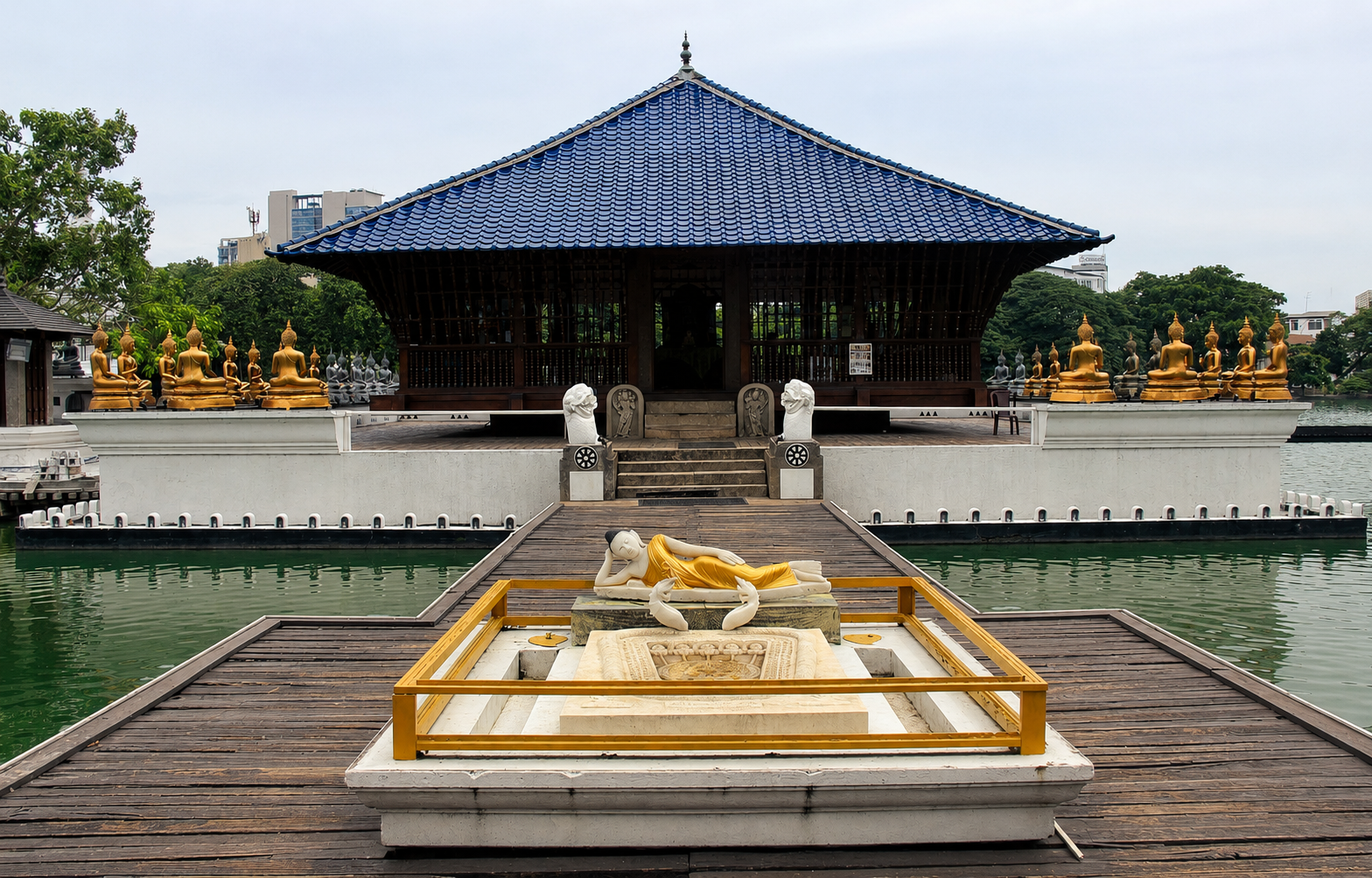
A sacred island floating on Beira Lake — where stone meets water, silence meets city, and the eternal meets the everyday.
The Sacred Story
Seema Malaka is one of Sri Lanka's most extraordinary religious and architectural achievements — a Buddhist ordination and meditation sanctuary that appears to float serenely on the surface of Colombo's Beira Lake, connected to the shore only by slender wooden bridges.
"The whole island seems to breathe — the water, the stone, the silence. It is a place that exists outside of time."
Originally a 19th-century meditation platform, the complex was reborn in 1978 when legendary Sri Lankan architect Geoffrey Bawa redesigned it as a series of three concentric circular platforms, each rising above the water like lotus petals unfolding from the lake. The result is a masterwork where ancient Buddhist spatial philosophy meets modern architectural genius.
The Design Language
Seema Malaka's architecture is a conversation between Buddhist cosmology and the natural world — three concentric platforms that mirror the ripples of rain on a still lake.
Three circular platforms echo the Buddhist concept of the Three Jewels — the Buddha, the Dhamma, and the Sangha. Each ring is a realm of sacred meaning, drawing the devotee inward toward enlightenment.
Rather than conquering the lake, the structure becomes part of it. The platforms are built at water level so that at high lake stages, Beira Lake seems to merge seamlessly with the island's stone edges — blurring the boundary between sacred and natural.
Over one hundred ancient bronze Buddha statues from across Asia are placed throughout the platforms, facing outward over the water — a spiritual assembly watching over the city of Colombo as it rushes past on all sides.
At the heart of Seema Malaka rises the main shrine pavilion — a multi-tiered roof of steel and tile inspired by Sinhalese architecture, sheltering a principal Buddha statue and the ordination chamber used by Gangarama's monks.
Geoffrey Bawa's genius was in the details: the precise height of each platform relative to the waterline, the placement of steps that seem to descend directly into the lake, and the walkways that make the crossing feel like stepping into another world entirely.
By day, Beira Lake mirrors the island's silhouette in shimmering water. By night, the bronze statues and oil lamps cast gold reflections across the surface — creating a double world, one real, one ethereal, that has captivated artists and pilgrims alike.
Sri Lanka's greatest architect, Geoffrey Bawa transformed Seema Malaka from a modest 19th-century meditation platform into one of Asia's most celebrated religious buildings. His philosophy of "tropical modernism" — where architecture dissolves boundaries between inside and outside, building and nature — found its purest expression on Beira Lake.
Bawa described his approach as placing buildings where nature already wanted something to exist — Seema Malaka is the water's own temple, shaped by human hands.
Bawa redesigned the island in 1978, working with the existing spiritual use while creating an entirely new spatial experience rooted in Sinhalese Buddhist cosmology.
His masterful use of low platforms, open-air corridors, and water proximity means visitors experience weather, light, and sound in ways impossible in any enclosed building.
Today Seema Malaka is considered among the finest works in the entire Bawa architectural legacy, featured in global surveys of 20th-century sacred architecture.
The Three Platforms
Each of the three concentric platforms holds a distinct spiritual function, guiding devotees from the everyday world through layers of sacred space toward the divine centre.
Platform 01
The widest platform forms a processional promenade around the entire island. Over one hundred bronze Buddha statues seated along its edge look outward over Beira Lake, creating a silent assembly of contemplation that greets every visitor crossing the bridge.
Learn MorePlatform 02
The intermediate platform is the place of offering and prayer. Devotees place flowers, light oil lamps, and present incense here while facing the central shrine. At festivals, this ring is covered in white lotus blossoms — a floating garden of devotion that draws thousands every year.
Learn MorePlatform 03
The innermost and most sacred platform contains the main shrine and the ordination chamber — the Sima. Buddhist monks have been ordained here for centuries, their vows witnessed by the lake, the bronze assembly, and the city beyond. It is a place of profound transformation.
Learn MoreYour Journey
From the moment you cross the bridge to your final breath of lake air walking back — here is the living rhythm of Seema Malaka's sacred hours.
Dawn · 5:30 AM
Monks begin morning chanting as the first light touches the water. The lake is still, and the sound of Pali scripture drifts across Beira Lake before the city awakens. A rare and deeply moving experience for early visitors.
Morning · 8:00 AM
Walking the slender wooden bridge over Beira Lake — with traffic and city noise behind you, and silence ahead — is a profound psychological transition. Geoffrey Bawa designed this journey as an intentional act of departure from the everyday world.
Mid-Morning · 10:00 AM
Walk the outer ring slowly, observing each of the one hundred bronze Buddhas from different centuries and traditions — Thai, Sinhalese, Burmese, Chinese. Each figure carries a unique mudra, a different gesture of teaching, meditation, or compassion.
Midday · 12:00 PM
Seated at the inner sanctum, with the lake shimmering in all directions and the incense drifting from oil lamps, visitors describe an experience of profound stillness unlike anything available in modern urban life. Bring a journal or simply breathe.
Dusk · 6:00 PM
At sunset, the entire island turns to gold. The late afternoon light catches the bronze statues, the gilded roof finials, and the water surface simultaneously — producing a moment of such beauty that many visitors describe it as a turning point in their understanding of sacred architecture.
Evening · 7:30 PM
After dark, oil lamps illuminate the platforms and their reflections dance on the water below. The city's lights ring Beira Lake on all sides, yet here in the centre, the ancient world holds. Seema Malaka by night is one of Colombo's greatest secrets.
Photography & Moments
Water, stone, bronze, and sky — the visual poetry of a sacred island captured across seasons and hours.
Visitor Guide
Seema Malaka is a living temple — active and sacred. Please approach with the reverence the space deserves. Dress conservatively, speak softly, and allow the lake to slow your pace.
Open daily from 6:00 AM to 10:00 PM. Dawn and dusk hours offer the most serene experience. The island remains open during Poya (full moon) days with special ceremonies.
Entry to Seema Malaka is free for worshippers. A small donation to the Gangarama Temple welfare fund is welcomed. Guided tours are available from the main temple complex.
Seema Malaka is located within the Gangarama Temple complex on Sri Jinarathana Road, Colombo 2. The island is accessible via the Gangarama main temple entrance, a 5-minute walk from the Slave Island tuk-tuk point.
Remove footwear before crossing the bridge. Shoulders and knees should be covered — wraps are available at the entrance. Photography is welcome on the outer ring; please refrain inside the ordination chamber.
Poya Day evenings (full moon), the Navam Perahera festival in February, and the Vesak full moon in May offer extraordinary experiences. The island is dramatically beautiful at both sunrise and after 7 PM on any evening.
Part of Gangarama Temple
Seema Malaka is one of six extraordinary sacred sites within the Gangarama Temple City Tourism experience. Explore the main temple complex, the living museum, and the Navam Perahera experience.
Explore Full Temple ComplexExperience Seema Malaka
Walk across the water. Sit among a hundred bronze Buddhas. Watch the city blur into silence. Let the lake show you what stillness truly means.